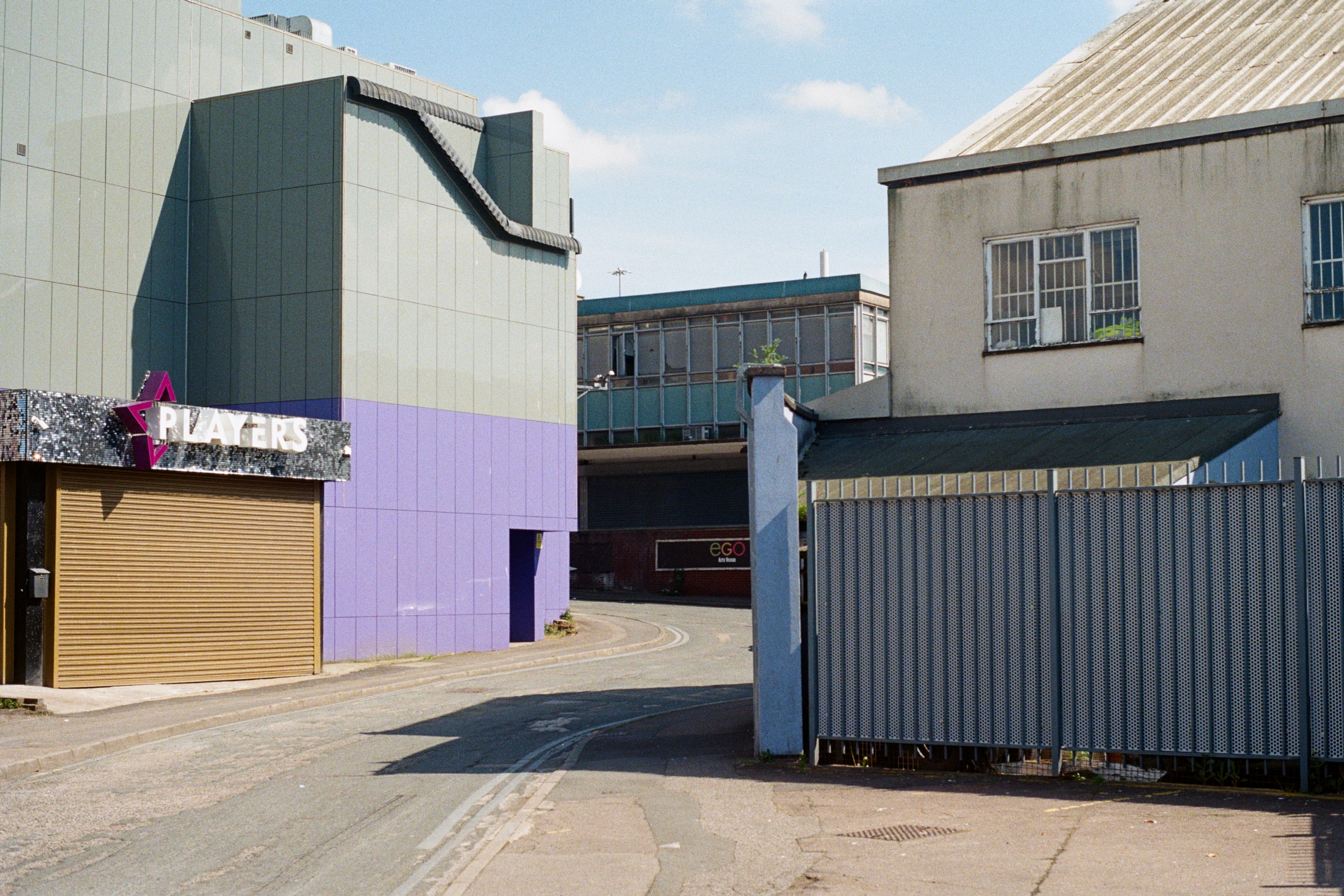
In the mid-1970s, a group of earnest photographers coined the term New Topographics to document the quiet, unvarnished collision between human civilization and the natural landscape.
It is entirely possible they did not anticipate purple panelling quite this intense.
The scene before us is a triumph of British post-industrial town planning, an art form based almost entirely on the principle that if you join enough completely unrelated geometric shapes together with mastic sealant, a town centre will eventually happen.
To the left stands PLAYERS, a venue whose shuttered facade radiates the distinct, heavy silence of a place that, at 2:14 AM on a Saturday, smells entirely of VK Blue, dry ice, and profound personal regret. Its lilac-and-slate exterior suggests an architect who was handed a set of children’s building blocks and told to make them look “vaguely nocturnal.”
Across the tarmac, a perforated steel security fence stands guard over nothing in particular, keeping the empty asphalt safe from the adjacent concrete. In the background, a single weed sprouts optimistically from a roof gutter—nature’s slow, patient reminder that long after the basslines have faded and the cladded facades have surrendered to the damp, biological life will still find a way to loiter behind the bins.